


hCB1(2)
品系全名
C57BL/6JSmo-Cnr1tm2(hCNR1)Smoc
目录号
NM-HU-250165
品系状态
活体
基因信息
基因名
Cnr1
品系描述
验证数据

Fig.1 Detection of CNR1 expression in cerebellum by RT-PCR. Cerebellum RNA was extracted from wild-type C57BL/6 mice and homozygous hCB1(2) knockin mice, then cDNA libraries were synthesized by reverse transcription, followed by PCR with mouse or human mRNA primers (n=2, male, 7 weeks old). Mouse Cnr1 mRNA (373 bp) was detectable only in wild-type C57BL/6 mice. Human CNR1 mRNA (209 bp) was detectable only in homozygous hCB1(2) knockin mice but not in wild-type mice.
Abbr. M, marker; HO, homozygous; WT, wild type.
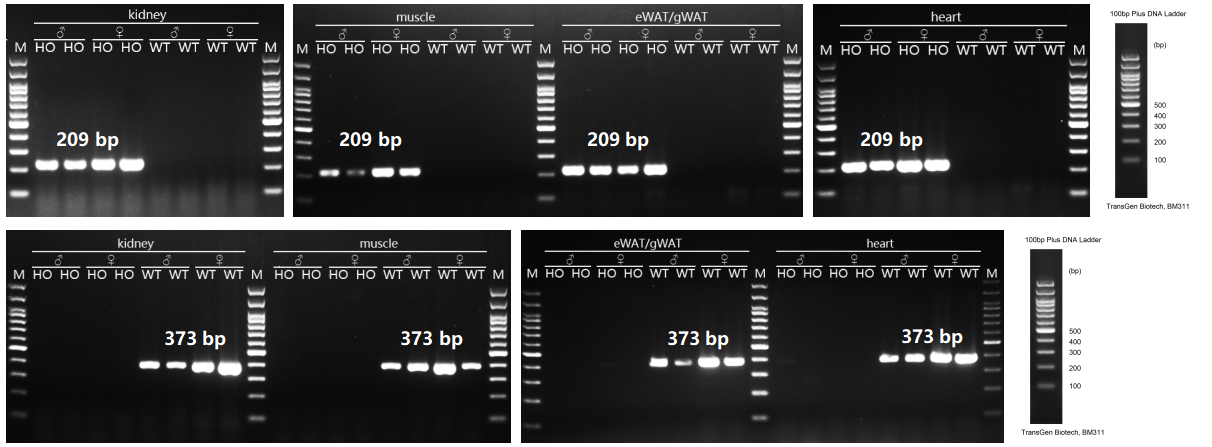
Fig.2 Detection of CNR1 expression in muscle, heart, kidney, epididymal White Adipose Tissue (eWAT of male) and gonadal White Adipose Tissue (gWAT of female) by RT-PCR. Mouse Cnr1 mRNA (373 bp) was detectable only in wild-type C57BL/6 mice. Human CNR1 mRNA (209 bp) was detectable only in homozygous hCB1(2) knockin mice but not in wild-type mice. Tissues RNA was extracted from 7-week-old male and female wild-type C57BL/6 (WT)(n=4) and homozygous hCB1(2) knockin mice (HO) (n=4), then cDNA libraries were synthesized by reverse transcription, followed by PCR with mRNA primers.
Abbr. M, marker; HO, homozygous; WT, wild type.

Fig.3 Detection of CB1 expression in hCB1(2) mice by WB. CB1 protein was detectable obviously in brain and BAT, while not obvious in total tissue lysates of liver, kidney and mammary gland from both WT C57BL/6 and HO hCB1(2) mice, as the antibody is cross-reactived between human and mouse CB1. The brain, liver, kidney, mammary gland and BAT tissue lysates were collected from female 7-week-old wild-type C57BL/6 mice and homozygous hCB1(2) mice, and then analyzed by western blot with anti-CB1 antibody.
Abbr. HO, homozygous; WT, wild type. M, marker; BAT, brown adipocyte tissue.
Note. The arrow indicates the target strip.

Fig.4 Detection of CB1 expression in hCB1(2) mice by WB. CB1 was detectable in eWAT/gWAT, iWAT, muscle, kidney and heart from both WT C57BL/6 and HO hCB1(2) mice , as the antibody was cross-reactived between human and mouse CB1. The eWAT/gWAT, iWAT, muscle, kidney and heart tissue lysates were collected from 6-7-week-old wild-type C57BL/6 mice and 7-week-old homozygous hCB1(2) mice, and then analyzed by western blot with anti-CB1 antibody.
Abbr. HO, homozygous; WT, wild type; M, marker; WAT, white adipocyte tissue; PC, mouse brain tissue lysates.
你也可能感兴趣
Tamoxifen诱导Cre-ERT2小鼠 使用指南
Cre-ERT2在无Tamoxifen诱导的情况下,在细胞质内处于无活性状态;当Tamoxifen诱导后,Tamoxifen的代谢产物4-OHT(雌激素类似物)与ERT结合,可使Cre-ERT2进核发挥Cre重组酶活性。
查看Cre-lox系统介绍及使用汇总
你一定听说过Cre-lox重组系统,无论你是否直接进行过基因操作。由于Cre-lox系统具有操作简单、重组率高的优点,如今已经成为体内外遗传操作的强有力工具。利用Cre-lox系统,可以在特定细胞、组织或整个生物体,甚至在特定时间点敲除或表达某个基因,实现对特定基因的时空特异性操作,这对基因功能的研究和人类疾病动物模型的建立都具有深刻影响。
查看


