


Pah-R408W
品系全名
C57BL/6Smoc-Pahem(R408W)Smoc
目录号
NM-KI-225103
品系状态
活体
基因信息
基因名
Pah
品系描述
验证数据

Fig.1 Detection of Pah expression in the liver by RT-PCR.
Wild type and Homozygous: one band at 328 bp with primers F1/R1(mPah) and one band at 123 bp with primers F/R(mGapdh).
Abbr. M, DNA marker; HO, homozygous; WT, wild type.

Fig.2 mRNA sequencing of Pah-R408W mice.
Sequencing data of RT-PCR products confirmed the presence of mutations in the Pah-R408W mice.
Abbr. HO, homozygous; WT, wild type.
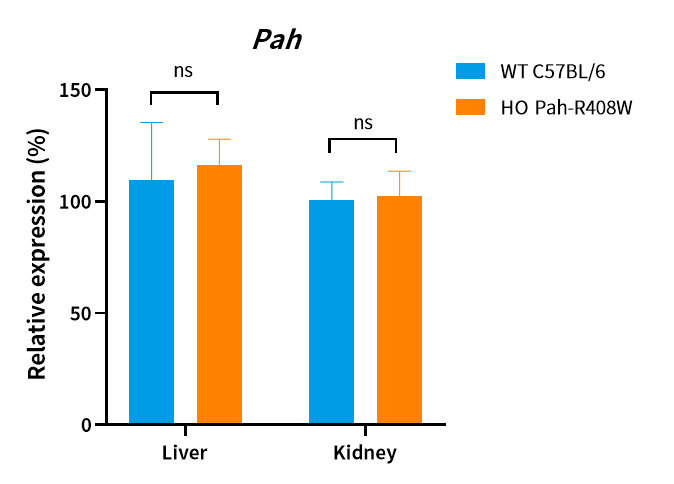
Fig.3 Detection of Pah expression in the liver and kidney by qPCR. (male, n=4 in both groups of the liver detection and n=3 in both groups of the kidney detection, Mean ± SEM. t-test, ns: no significance).

Fig.4 Detection of mouse PAH expression in Pah-R408W mice by WB.
Abbr. M, marker; WT, wild type; HO, Homozygous; PC, positive control, HepG2 cells.

Fig.5 Basic phenotype detection of HO Pah-R408W mice.
(A) Representative photograph showing that Pah-R408W mice exhibit a light-colored hair phenotype compared with WT mice. (B) Body weight analysis indicating that Pah-R408W grow more slowly than WT mice. (C) Brain weight analysis demonstrating that the brain weight of Pah-R408W mice is significantly reduced compared with that of WT mice, suggesting impaired locomotor activity in Pah-R408W mice. (male, C57BL/6: 9wks, Pah-R408W: 9.5wks, n=3 in both groups, Mean ± SEM. t-test, **P < 0.01).

Fig.6 Detection of the locomotor ability by rotarod test.
The rotarod test was performed to evaluate the locomotor function in mice. The result indicated that the Pah-R408W group exhibited shorter latency to fall from the rotating rod compared to WT mice, demonstrating impaired locomotor performance in the Pah-R408W group. (male, C57BL/6: 9.5wks, Pah-R408W: 10wks, n=8 in both groups, Mean ± SEM. Mann-Whitney test, *P < 0.05).
Abbr. WT, wild type; HO, Homozygous.

Fig.7 Detection of the locomotor ability by pole test.
The pole test was also conducted to evaluate the locomotor function in mice. Results revealed that the Pah-R408W group exhibited significant longer time to turn (A) on the pole and to descend (B) compared to WT mice. These findings indicated impaired locomotor performance in the Pah-R408W group. (male, C57BL/6: 9.5wks, Pah-R408W: 10wks, n=8 in both groups, Mean ± SEM. Mann-Whitney test for A, t-test for B, ***P < 0.001).
Abbr. WT, wild type; HO, Homozygous.

Fig.8 Detection of the cognitive behavior by novel object recognition test. The result showed that there is no significant difference between the two groups in cognitive behavior. (n=8 in both groups, Mean ± SEM. t-test).
Abbr. WT, wild type; HO, Homozygous.

Fig.9 Detection of the cognitive behavior by Y-maze test. The result showed that there is no significant difference between the two groups in learning and memory behavior. (n=8 in both groups, Mean ± SEM. t-test).
Abbr. WT, wild type; HO, Homozygous.

Fig.10 Detection of amino acid metabolites in serum of Pah-R408W mice by LC-MS. Results showed that (A) L-Phenylalanine and (C) 4-Acetamidobutyric acid significantly increased in HO Pah-R408W mice, while (B) the ratio of L-Tyrosine/L-Phenylalanine, (D) 5-Hydroxy-Tryptamine and (E) α-Aminoadipic acid reduced in HO Pah-R408W mice, compared with WT mice. (n=3 in both groups, Mean ± SEM. t-test, *P < 0.05, **P < 0.01, ****P < 0.0001).
Abbr. WT, wild type; HO, Homozygous.
Table 1. Detection of metabolites concentrations in the serum of the homozygous Pah-R408W mice.

你也可能感兴趣
Cre-ERT2在无Tamoxifen诱导的情况下,在细胞质内处于无活性状态;当Tamoxifen诱导后,Tamoxifen的代谢产物4-OHT(雌激素类似物)与ERT结合,可使Cre-ERT2进核发挥Cre重组酶活性。
查看


